Slim Patch vs Slimming Creams and Gels: Which Works Better?
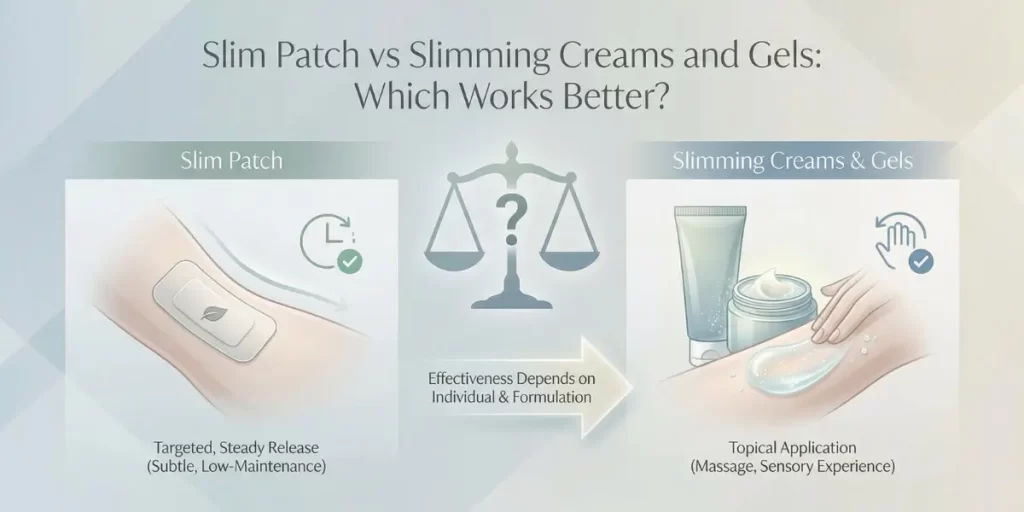
Walk into almost any US retail aisle with body contouring products, or browse a few weight loss clinic storefronts online, and you will see the same promise packaged in different formats: patches, creams, gels, and roll ons that claim to help with “stubborn fat,” “water weight,” or “toning.”
If you are trying to decide between a patch and a topical product, you are not alone. Communities that review OTC weight loss products in the United States talk about this constantly, especially around “targeted” belly fat and quick cosmetic changes before events.
This guide is here to help you compare slim patch vs slimming creams in a way that is simple, grounded in how these products are actually regulated and labeled, and honest about what current evidence can and cannot support.
But before we start it is important to note that no OTC patch, cream, or gel can legally claim to treat obesity or cause meaningful fat loss like a prescription medication. In the US, most of these products are sold as cosmetics, dietary supplements, or “homeopathic” products depending on the brand’s positioning and label. That matters, because it affects what they can contain and what they can credibly promise.
Comparing Slim Patch vs Slimming Creams and Gels
What Is a Slim Patch
A slim patch is typically a transdermal style patch applied to skin that claims to deliver ingredients over time. Some are marketed as dietary supplements (with a Supplement Facts panel), others as cosmetic or “homeopathic” patches. Most are used on the arm, back, or abdomen and worn for several hours.
If you want a deeper overview, read more about here: What Is a Slim Patch?.
What are slimming creams and gels?
Slimming creams, gels, and similar rub on products are topical slimming items applied directly to the skin, often on the belly, thighs, arms, or hips. They are usually sold as cosmetics. Their main claims tend to be cosmetic, like “firmer looking skin,” “reduced appearance of cellulite,” “tightened look,” and “temporary inch loss.”
People often call them “body contouring products,” and that is an accurate framing. They are mostly about appearance and feel, not true fat reduction.
Slim patch vs slimming creams: The core difference
Thinking of it this way is the most straightforward way:
Patches are typically taken to be more of a delivery method where the patch will provide your body with the ingredients through your skin.
Creams and gels are typically used to address more than just the skin’s surface and upper layers; they tend to provide only a temporary effect on your skin, such as hydration, cooling, heat, or firmness/smoothness of your skin.
That does not automatically mean patches “work better.” It means they are making a different kind of implied promise, and the burden of proof is higher. The table below gives you a basic summary of the two.
| Feature | Slim Patch | Slimming Creams and Gels |
|---|---|---|
| Primary goal people expect | Appetite control, metabolism support, belly fat support | Tighter look, smoother look, temporary de puffing, cellulite appearance |
| Typical regulatory category in US | Dietary supplement patch, cosmetic, or homeopathic | Mostly cosmetic |
| Label you should look for | Supplement Facts (if supplement) or active ingredients list | Ingredient list and any drug facts if it claims drug like effects |
| Evidence strength for fat loss | Generally limited | Generally limited for fat loss, better for cosmetic skin effects |
| Speed of noticeable change | Sometimes subtle, days to weeks if anything | Often immediate feel (cooling or warming), visual changes may be temporary |
| Best case use | Routine support tool for motivated users who track results | Event prep, massage routines, hydration and firm look goals |
| Main downside | Unclear absorption, inconsistent dosing, skin irritation | Temporary effects, can irritate skin, not true fat loss |
What the science really says?
1) Can topical ingredients melt fat?
For most OTC ingredients, true fat breakdown from the outside is not realistic. Your fat cells live below the skin in a layer called subcutaneous fat. Most cosmetic ingredients do not penetrate deeply enough in meaningful amounts to “burn” fat.
What topicals can do more reliably is:
- Temporarily tighten the look of skin by dehydration or film forming ingredients
- Reduce the look of puffiness through massage and cooling sensations
- Make cellulite look smoother for a short time by hydration, light reflection, or swelling changes
So if your goal is genuine weight loss, the honest answer is that neither category should be your main strategy. But if your goal is appearance based body contouring, creams and gels often provide more immediate feedback.
2) Can patches deliver weight loss ingredients effectively?
Transdermal delivery works best for small molecules designed for skin absorption, at specific doses, with validated patch engineering. That is why prescription transdermal systems exist for certain medications.
For OTC slimming patches, the big question is not “do these ingredients have any evidence when swallowed?” The question is “do they reliably absorb through the skin at a meaningful dose?” And most brands do not provide clinical absorption data.
So patches can feel convenient and “medical,” but convenience does not equal proof.
Read the label like a pro: Supplement facts is your anchor
If a slim patch is marketed as a dietary supplement, it may include a Supplement Facts panel. That is useful, because it forces disclosure of:
- Ingredient names
- Amount per serving (sometimes)
- Serving size (for patches, sometimes defined as one patch)
A lot of frustration in OTC weight loss communities comes from patches that list blends but do not clarify how much is delivered through the skin.
Here is what to look for:
- Does the brand list amounts in milligrams?
- Is it a proprietary blend with no individual amounts?
- Does it state a wear time and a “serving” definition clearly?
- Does it include stimulant ingredients and warnings?
For creams and gels, you typically will not see Supplement Facts. You will see an ingredient list. That means your evaluation is more about irritants, skin feel, and realistic claims.
Slim Patch Vs Slimming Creams: Common Ingredients Lists
Now let’s focus on the typical categories you may see on Supplement Facts or ingredient lists and what they realistically imply.
Common patch ingredient themes
- Caffeine and “stimulant like” botanicals
- Green tea extract, green coffee, guarana
- Garcinia cambogia, glucomannan, other “diet” ingredients
- Vitamins and minerals
These ingredients are commonly used in oral weight-loss supplements. However, there are limited evidences tha they are capable of of producing meaningful fat loss.
Common cream and gel ingredient
- Caffeine in a cream
- Menthol, camphor, cooling agents
- Capsaicin or warming agents
- Film formers and tightening polymers
- Plant oils and moisturizers
These ingredients often create temporary sensations (cooling or warming) or mild skin tightening effects. This make the treated area feel firmer or look slightly smoother for a short time.
“Slim Patch for Belly Fat”: what to expect realistically
The phrase Slim Patch for Belly Fat is popular because belly fat feels personal. It is also where marketing gets the most aggressive.
Here is the reality: spot reduction is not how human physiology typically works. Fat loss tends to happen systemically based on energy balance, genetics, hormones, sleep, and activity.
What you may notice from a belly focused product is:
- Temporary reduction in puffiness from massage and reduced bloating behaviors
- Temporary smoothing and firmer look from topical effects
- A behavior change effect, meaning wearing a patch or applying a gel reminds you to stay consistent with your plan
That behavior reminder can be valuable, and it is not “fake.” It is just different from a direct fat burning mechanism.
Slim Patch Myths vs Facts
Use this section as your internal filter when you read ads, TikTok reviews, or marketplace listings.
Myth 1: “If I feel heat or tingling, it is burning fat”
Fact: Heat, cooling, tingling, and redness are usually skin sensory effects. They can come from menthol, capsaicin, fragrance, or irritation. Sensation is not proof of fat loss.
Myth 2: “Transdermal means it bypasses digestion so it is stronger”
Fact: Bypassing digestion can be beneficial for certain medications, but it is not automatically stronger for supplements. Skin is a barrier. Many compounds do not absorb well.
Myth 3: “If it is natural, it is safe for everyone”
Fact: Natural ingredients can still irritate skin or interact with medications. People with sensitive skin, pregnancy, nursing, or medical conditions should be extra cautious and ask a clinician.
Myth 4: “One patch replaces diet and exercise”
Fact: If a product sounds like it replaces lifestyle fundamentals, it is marketing, not physiology.
Which works better depends on your goal
Let us get very practical. In real world use, people are usually looking for one of three outcomes.
Goal A: Scale weight loss over weeks to months
Neither patches nor creams are a reliable primary tool for this. If a clinic or retailer is positioning them for serious weight reduction, it is worth asking what outcomes they are measuring, and whether they are pairing it with nutrition coaching, activity, sleep, and medical screening.
If you still want to choose between them as an add on:
- A patch may be preferred by someone who hates applying products and wants a simple routine.
- A cream or gel may be preferred by someone who likes massage and wants visible skin improvements.
Goal B: Cosmetic tightening or smoother looking skin
Creams and gels usually win here. They are designed for surface level changes, and users often feel something immediately.
Goal C: Belly area confidence and consistency
This is where patches surprisingly do well for some users, not because they melt fat, but because they create consistency. Wearing a patch can be a daily cue that keeps someone engaged with healthier habits.
Safety and tolerability (this matters for clinics and retailers)
Both categories are “OTC,” but that does not mean zero risk.
Common issues reported with patches and topicals:
- Contact dermatitis or irritation from adhesives, fragrances, menthol, or warming agents
- Rashes from occlusion, meaning the skin cannot breathe under a patch
- Sensitivity reactions, especially if used after shaving or on broken skin
- Overuse, meaning applying too often or leaving on too long
Practical safety tips that are education only:
- Patch test any topical on a small area first
- Avoid broken skin
- Stop if irritation happens and do not push through it
- Be cautious with layering multiple products on the same area
How weight loss clinics and OTC buyers can position these responsibly
If you are selling or recommending these products, the most sustainable strategy is to position them as:
- Body contouring products for appearance support
- Comfort and skin feel products
- Routine tools that support adherence, not replacements for evidence based care
Clinics that do well with retail add ons often:
- Educate patients on realistic timelines
- Encourage measurement methods that match the claim (photos for skin changes, tape measure for temporary swelling changes, and scale trends for overall weight)
- Avoid “spot reduction” promises
Retailers who reduce returns and complaints:
- Use clear expectation setting signage
- Provide ingredient focused education and sensitivity warnings
- Suggest fragrance free options for sensitive skin shoppers
Key Takeaway: Which ones work better?
In terms of cosmetic appearance and instant skin benefits and uses, a lot of folks feel like gels and creams for firming, smoothing, or cooling work better.
And if it is about convenience and how you apply them every day, a lot of people feel like patches work better since you just have to put them on and forget about them (no reapplying).
In terms of actual body fat loss, neither product will work on their own, so any large fat loss claims made by OTC topical products really shouldn’t be considered credible.
When making your own choice, a good rule of thumb is to choose one product type to use for 2-4 weeks and measure the actual outcomes (skin appearance, clothing fit, and habit reinforcement).
Resources:
What Is a Slim Patch? Uses, Ingredients, and Realistic Results
What Does Current Evidence Say About Slim Patch Results and Timeline?
Who Should Use a Slim Patch? Ideal Body Types & Fitness Levels